I've always pronounced it "Newcastle", in the way that those from the South (or should that be civilzation?) pronounce it. Although I have noticed that many news readers have started to apply regional accents and have started to say "Newcastle".
Well, however it is pronounced it is this city that has been subjected to my ongoing quest to visit as many independent record shops as possible.
Actually, the purpose of the trip was to move my step-daughters stuff out of her University Halls of Residence pending her moving to a new shared house in a couple of weeks (fortunately, it's not me who is making the return trip).
Observations of the journey:
it's a bloody long way
why does my SatNav want to send me along the M40? M4, M25, M1 and keep going is surely the most direct route, but no Mrs SatNav Woman has decided that I should go A34, M40, M42, M6, M1. Seems a bit convoluted to me, and I think she threw a major strop when I proceeded down the M4 towards Slough (in fact she didn't speak to me again until Luton)
it's further than I thought
Upon arrival in Newcastle (via Gateshead) the first thing that you notice is that East side of the city (Jesmond-area) appears to be one big Motorway Interchange.
Without wishing to re-enforce the stereotype, as I passed York, the sky turned grey and it started raining (It's grim up north etc ...)
So, freshly ensconced into the Hotel room, I use the wifes Tablet to search out the record shops the city has to offer. Excluding, the ever-present (and often hilarious) HMV, there are seven potential shops to visit.
Of this, I discount 2 immediately as one is a sheet music specialist, and the other is more of a Vintage Clothing store than a specialist record shop.
Next problem, a quick recce of the area, and it looks like 3 more of the remaining five may not have a bricks and mortar presence anymore (or I just missed them - I'm not a local, but I am English and a bloke, so therefore refuse to ask for directions).
This leaves just two shops on the list (Reflex and RPM Music).
At this point, I become slightly apologetic, and confess that from a starting list of 7, I only managed to visit 1 shop.
That shop was Reflex, a small (but perfectly formed, and as I discovered a perfectly stocked) unit down a side road, just up from the station. Came away with a couple of additions, but could easily have spent a few more hours (and lots more £) in that fine emporium.
There is now a simmering frustration/annoyance within me that I didn't get to the other shops. Maybe a return trip is needed, although there is something against this - did I mention that it is a long, long trip?
I also visited the once mighty, now generally laughable, HMV. The store itself boasted a 70% Stock Clearance Sale (due to Store re-location). "This might be interesting", I thought. To answer in a few words - it wasn't!
Yes, there were some serious price reductions on some items, but not on the main stock. What was reduced was the detritus that had been clogging up their store room and they had never been able to shift.
So what did I get?
Not as much as I wanted to from Reflex, and not as much as I'd hoped for from HMV.
The one main addition, that will now be forever linked to Newcastle in my head, was 'HQ' by Roy Harper.
Roy Harper is a name I knew, but had never knowingly heard. He has released 22 albums in nearly 50 years of recording, and I have only heard "Tom Tiddlers Ground" and his vocal contribution to Pink Floyds "Have A Cigar".
So why this album from 1975? Before venturing north, I had ordered a 2005 compilation ('Counter Culture') from an internet retailer with a "flexible" taxation relationship with the UK Exchequer, so I wasn't looking for a career spanning retrospective, but this album contains the one other song Roy Harper I have heard of (if not heard): "When An Old Cricketer Leaves The Crease"
Two local Midlands bands (The N'Betweens and The Mavericks) met up on a ferry to Germany. N'Betweens drummer (Don Powell) and guitarist (Dave Hill) asked The Mavericks vocalist if he'd be interested in joining them.
Noddy Holder said: "No"
A couple of months later, they met up again in Wolverhampton, and this time Noddy said "Yes" (bassist Jim Leas had recently joined the N'Betweens).
Slade (as they would later become known) was born.
Still playing around the Midlands. the band were spotted by Fontana Records, spent week in Phillips Records studio and were subsequently offered a record deal on the stipulation that (a) they change their name, and (b) get a manager.
Despite the bands unhappiness with the record companies choice of name (Ambrose Slade) the arrival of Chas Chandler as Manager signaled the beginning of a fruitful and successful relationship.
Ambrose Slade's first album ('Beginnings') was a mixture of cover versions (including "Born To Be Wild", "Martha My Dear" and "Journey To The Centre Of Your Mind") and band originals (including the first single "Genesis" which didn't trouble the chart compilers).
The bands second single ("Wild Winds Are Blowing" (released as The Slade)) fared no better than the first, and the band returned to the studio with a shortened name and shortened hair (the band adopted skinhead look and a tougher sound, although still rooted in R&B).
Another two singles ("Shape Of Things To Come" and "Know Who You Are") flopped, and the parent album 'Play It Loud' continued the disappointment.
Their next single attempted to capture the rawness and atmosphere of their live shows. "Get Down And Get With It" was released in May 1971 and started a slow rise, cracking the Top 20 in August 1971.
Their next single was a Noddy Holder/Jim Lea composition, and the first to feature their (sonn to be) trademark mis-spelling/phonetic spelling.
"Coz I Luv You" came out in October 1971, and two weeks later was sitting at Number 1 where it stayed for four weeks.
This was the start of a golden 5 year period, with the next 11 singles all achieving Top 4 placings, including 5 further Number 1 singles (3 entering the chart in pole position, one of which was "that song"): "Look Wot You Dun", "Take Me Bak 'Ome" , "Mama Weer All Crazee Now", "Gudbuy T'Jane", "Cum On Feel the Noize", "Skweeze Me, Pleeze Me",
"My Friend Stan", "Merry Xmas Everybody", "Everyday", "The Bangin' Man", "Far Far Away"
This run ended in 1975 when "How Does It Feel?" rose no higher than number 15.
In addition to the singles, Slade were considered a formidable proposition live, and thier first album of this period ('Slade Alive') hit number 2 in mid-1972. The next album ('Slayed?') released at the end of the year went one better. All of the singles to date were brought together on the album 'Sladest' which also hit number 1, and 1973 and 1974s 'Old New Borrowed And Blue' repeated the feat.
Towards the end of 1974, the idea of a film was mooted - several ideas were considered, before settling on the film "Flame". Although not being trained actors (they were musicians, in case you weren't aware!), each of the band gave strong performances as members of the fictional band, charting their struggle to make it, their rise and their ultimate fall.
Latterly, the film has been spoken of as an object lesson in how to "do" a rock band film, but at the time was dismissed by large sections of the media.
The attendant Soundtrack album ranks, along with 'Old New Borrowed And Blue' as the zenith of their Long Playing output. The 'Flame' album contains both Noddy Holders favourite song ("Far Far Away"), and the masterpiece that is "How Does It Feel" (yes, the song that broke Slades Top 10 appearance run, but surely ranks as one of the finest songs ever written).
The relative failure of Flame coincided with a downturn in Slade's recording fortunes. 1975s "Wham Bam Thank You Mam" restored them to the Top 10, but by the middle of the year the band had virtually permanently re-located to America in search of a new audience and the elusive US Breakthrough (which sadly for the band, never happened). Slade toured heavily and despite some favourable reception in some parts of the country, this success was not transferred across the continent (yet!).
In the midst of touring, Noddy Holder and Jim Lea started writing and recording the next album.
The first two singles ("In For A Penny" and "Lets Call It Quits" hit number 11, and the parent album ('Nobodys Fools') hit the Top 20. The following single "Nobodys Fools" failed to chart, the first time a Slade single had stiffed since since "Know Who You Are" in 1970.
'Nobodys Fools' is not a bad album, I think it suffers more that the band were stuck in America so the opportunity for promotion in the UK was limited (if not non-existent).
One can't help notice the strangely prophetic title of their last Top 20 single: "Lets Call It Quits". With the band resident in the UK, it seems that the public and the record company to some extent did. It would be another 5 years before Slade would grace the Top 20 again.
Returning from the US empty handed, Slade found themselves with a smaller audience, no record contract and a musical landscape that they were no longer part of.
The bands contract with Polydor was not renewed, and they were signed to Chas Chandlers independent Barn Records. Their first single was "Gypsy Roadhog" which despite the normal helping hand of a ban by the BBC crawled into the lower reaches of the Top 50. The album had another prophetic title with "Whatever Happened To Slade?". The record buying publics answer seemed to be "Don't know" as no-one bought the album.
A non-album single "Burning In The Heat Of Love" came out soon after. Another BBC ban offered no help other than to bury the single and it tanked (in chart terms).
7 further singles in 1978 and 1979, and the 1979 album 'Return To Base' all appeared on the label, and all sold in very small numbers (if at all). Despite these failures, the band retained their reputation as a live act, albeit in smaller venues.
In February 1980, despite Slades relatively low public profile, Noddy Holder was offered the job of replacing the recently deceased Bon Scott in AC/DC. Noddy never took up the position and the group re-convened to release an EP containing 3 tracks from their previous album, and 3 newly recorded tracks ("Six Of The Best"). As was becoming a pattern of expectation, the songs received limited airplay, limited distribution and as a result limited sales.
.. and that it seems was the end.
Apart from one last minute intervention of fortune:
In August 1980, both Ozzy Osbourne and Gary Moore pulled out of their scheduled slots on the bill at the Reading Festival. With less than a week to go (some stories state 3 days), the organisers needed ti find a replacement. Slade were considered and Chas Chandler put the idea to the band. Dave Hill had had enough at this stage and didn't want to be on stage anymore. The other 3 were more conducive, and with the help of Chandler managed to cajole Mr Hill into doing the show (it was sold to him as a final farewell show).
So, late afternoon the band walked on stage to a rapidly thinning crowd. 3 songs in, the crowd numbers were increasing, and the atmosphere hotting up into a party-like frenzy.
Just a week earlier, the band were about to pack it all in, now, two encores later, they were leading 70,000 rock fans in a chorus of "Merry Xmas Everybody" - in a field, in Berkshire, in the middle of August.
With a reception like that, and the ensuing press attention and airplay as a result of Radio 1 Rock Show 'Reading Special', this was far from a low key farewell. Signing soon afterwards to Cheapskate Records (part owned by Jim Lea), by September the "Live At Reading" EP was released. Whilst not exactly setting the charts alight, it delivered the highest chart position since 1976.
After a second EP ("Xmas Ear Bender") in November, the band returned to the studio to record a new batch of songs. Recorded in early January, the first fruits of these sessions was "We'll Bring The House Down" - Slade in full heavy rock mode - and the single flew into the Top 10.
The parent album was released in March and combined 6 tracks from the previous release ('Return To Base') and 4 new tracks.
The album ended their 5 year chart hiatus, and plans were drawn up for a European Tour. Due to their higher profile they were now able to leave the 'toilet circuit' and start returning to larger venues.
In August 1981 (having already turned down the offer to return to that years Reading Festival), Slade appeared on the bill at the Monsters Of Rock Festival alongside Blue Oyster Cult, Whitesnake and headliners AC/DC.
Two further singles were culled from the album to negligible success, apart from keeping the band in the publics attention, but did result in the offer of a new recording contract with RCA Records (unfortunately, the US was put on hold again as the new contract excluded Canada and America).
Minor success continued through late 1981 and 82, with the singles being well received and reviewed but only reaching the lower end of the charts. A similar fate befell the first RCA album "Til Deaf Us Do Part".
Despite no major success, RCA were nothing if not tolerant, and by mid-1983 Slade had the outline of a new album.
The first single, released before the album, was the piano-led folk-ish "My Oh My" which rose to Number 2 around Christmas 1983.the band went away to work on new material.
'The Amazing Kamikaze Syndrome' was released in December to capitalise on the success of "My Oh My" but sales were dis-appointing. A second singe from the album ("Run Runaway" was released in January, but the album only just scraped into the Top 50).
In another moment of either sheer luck, or the stars all aligning at the right moment, Slade finally managed to get noticed in America.
In late 1983, American Metal Band Quiet Riot released a cover version of "Cum On Feel The Noize" and broke into the American Top 10. RCA did not have rights in the US, so CBS (Quiet Riot's label) signed Slade, and "Run Runaway" was released in America and climbed into the Top 20 of the Billboard Hot 100. It may have taken 10 years, a change of record label and a couple of slices of luck, but the American breakthrough was sealed. The single was undoubtedly helped by heavy rotation of the video on MTV, and the next release ("My Oh My") was an MTV favourite too.
A re-packaged version of "The Amazing Kamikaze Syndrome" was released and achieved respectable sales. To push their US credentials, further a tour withe Ozzy Osbourne was planned. However, after a warm-up gig, Jim Lea was taken ill (later diagnosed as Hepatitis C). As a result of Lea's illness, increasing tensions within the band (possibly over spelling and grammar), and problems in Noddy Holder's personal life, the band returned to the UK never returning to the US again (or indeed tour any further).
It seems that in the eyes of the public, Slade will be forever associated with Christmas. Their next single ("All Join Hands") did little to change this view (and nor did the B-Side "Heres To ... The New Year"). This view was again re-enforced with release of 'Crackers - The Christmas Party Album' in late 1985.
Earlier in 1985, "Rogues Gallery" was an album intended to an "old fashioned" type album where every track could potentially be released as a single in it's own right. All good intentions, but the lack of air-play, promotion and live performance resulted in low sales for the album and it's 5 singles.
Slade's last studio album came in 1987. Complete with trademark mis-spelling 'You Boyz Make Big Noize' scraped into the Top 100 (just). The band were released from their contract at RCA and returned to their own Cheapskate imprint. Their next single, also called "You Boyz Make Big Noize" (which, confusingly, was not on the album that bore the title) fared not much better in chart terms.
Their last single was in 1991 - "Radio Wall Of Sound" - featured vocals from Jim Lea. The "official" story (and who am I to doubt it?) is that the song is in the wrong key for Noddy Holder's voice, but if you ever see the Top Of The Pops performance, Noddy does look somewhat detached from the rest of the band.
Noddy Holder announced his departure from the band in early 1992, to be swiftly followed by Jim Lea. Dave Hill and Don Powell continued as Slade II, but the 25 year up and down story was now at an end (unless Arctic Monkeys or Queens Of The Stone Age pull out of this years Reading Festival and a last minute replacement is needed ...
So - how to represent Slade in one (or possibly) two video clips?
From 'Beginnings', the production on this track is not the finest, but it does contain this track bears the foundationsShape Of Things To Come
From 'Flame', Noddy states the "Far Far Away" is his favourite. I re-iterate what I said above - Noddy is wrong, and this track is an absolute masterpiece - "How Does It Feel?":
Despite selling something like 455 billion singles between 1972 and 1974, the albums also contain a plethora of fine, fine songs. From 'Old New Borrowed And Blue' - "Miles Out To Sea"
And to think they nearly split up? This performance of "Wheels Ain't Coming Down" from the now legendary 1980 Reading Festival shows what a potent live band they were:
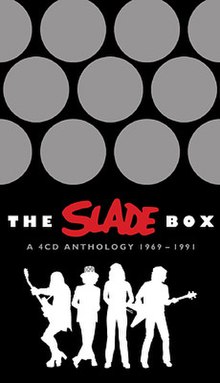
Slades 1970s output is widely known, but the 80s/90s output is often unfairly maligned, or indeed forgotten altogether. Whilst not necessarily as bombastic or "rabble rousing" (note to self: think of a better term!), the bands performance remains assured and held in check. It often feels like they could, at any given moment breakout into full heavy rock onslaught. To save a fortune on album investment, the easiest way to own this stuff, is The Slade Box Set.
Possibly (or perhaps apocryphally/mythologically?), the first use of the term "Heavy Metal" in print was from the pen of William Burroughs, and was used to describe the guitar sound created by The Byrds. "Heavy Metal" appears more clearly in the lyrics for Steppenwolf's "Born To Be Wild" from 1968.
Does it matter if either of these entomologies are true?
As a musical genre, it took the basis of blues, rock and psychadelia, turned up the volume and layered the sound with heavy, thick guitar riffs, power chords, screaming vocals and a thumping backbeat (you knew when it was loud enough because it shook the filling from your teeth).
Its earliest exponents are cited as Led Zeppelin, Deep Purple and Black Sabbath. Whilst all coming from a similar starting point, Led Zeppelin and Deep Purple augmented their sound with pastoral, folk and orchestral elements, whilst Black Sabbath added a darker, more introspective tone to proceedings.
One could almost include Status Quo in the pantheon of 70s Rock/Heavy metal catalysts. Other bands took the template, stripped back the blues noodling and went for the straight ahead, all out rock mode - Budgie and Judas Priest being perhaps the prime exponents of this sound in the middle(ish) 1970s. Also active at this time, delivering a nice line in hippy-infused Space were Hawkwind. Add in the influence of Motorhead (formed in 1975 following Lemmy's sacking from Hawkwind) and the template of late70s/early 80s Heavy Metal is set. And not just in terms of sound and attitude, but sartorially too (denim, leather, biker boots, studded armbands, bullet belts - it can all be traced to this point).
The advent of punk had shaken up the record business, and it was no shown to be perfectly possible to be successful with small, independent record releases
In the period 1977 -1979, possibly as a result of the Punk attitude and proof of 'doing it yourself' and relesing your own records on independent labels, a whole bunch of bands were breaking out of the industrial areas of the North-East, the Midlands and London, and many other metropolitan areas of Britain.
During late 1978 and early 1979, these bands were going into recording studios and making their first recordings. The results, when released, were often on small independent labels such as Gem, Bronze, Carrere, Logo and Neat (responsible for recording and issuing records by nearly evey band from the North East, including Tygers Of Pan Tang, Venom, White Spirit, Raven and Fist). In two notable cases a completely independent, self-financed label - Iron Maiden: The Soundhouse Tapes (Rock Hard) and Def Leppard: The Def Leppard EP (Bludgeon Riffola).
It may be coincidental, but not long after these releases cane the first metions in the UK Music Press. The first recorded mention in the national Music Press was by Geoff Barton in a May 1979 issue of Sounds.
If these releases are to be considered as the start of NWOBHM (not strictly true, but it is a good a marker as anything), then the two albums released by EMI in 1980 (and the associated EP) brought a host more bands to the attention of the public.
Metal For Muthas (released 1980)
Iron Maiden - Sanctuary
Sledgehammer - Sledgehammer
E. F. Band - Fighting for Rock and Roll
Toad the Wet Sprocket - Blues in A
Praying Mantis - Captured City
Ethel the Frog - Fight Back
Angel Witch - Baphomet
Iron Maiden - Wrathchild
Samson - Tomorrow or Yesterday
Nutz - Bootliggers
Metal For Muthas Volume II (released 1980)
Trespass - One of These Days
Eazy Money - Telephone Man
Xero - Cutting Loose
White Spirit - High Upon High
Dark Star - Lady of Mars
Horsepower - You Give Me Candy
Red Alert - Open Heart
Chevy - Chevy
The Raid - Hard Lines
Trespass - Storm Child
Muthas Pride (released 1980)
Wildfire - Wild Dogs
Quartz - Back in the Band
White Spirit - Red Skies
Baby Jane - Baby
Listening again, 34 years after original release, the contents of these 3 items still sounds good (Toad The Wet Sprocket stands out like a sore thumb amongst the other bands, but is not unenjoyable). Yes, it may sound dated in places and some of the production quality may leave a bit to be desired in comparison to modern recording, but there is a rawness and energy running through each track. If anything, and this maybe down to over-familiarity, or just basic musical snobbishness on my part, Volume II is a better listen than Volume I. The fact that it opens with this track probably has something to do with swaying my decision.
Trespass - One Of These Days
For me, the 2 main ommissions from these albums are Def Leppard (signed to Phonogram Records) and Diamond Head, the often (certainly at the time) forgotten third axis of NWOBHM influence.
Diamond Head released their first single (Shoot Out The Lights) and album (Lightning To The Nations) in 1980 on their own Happy Face Records, but it wasn't until 1982 that they landed a major record label contract (with MCA).
Sadly for Diamond Head, 1982 was probably the point where NWOBHM ceased to exist as a concept, or "thing" was pretty much all over by 1982.
It was at this point that the genre started to show signs of splintering. There was a certain mainstream commercial acceptance of the music and bands (Iron Maiden had a Top 10 single with Run To The Hills, Motorhead performed Ace Of Spades on The Young Ones (whose characters included Vyvyan, often wearing a Whitesnake T-Shirt and a studded denim jacket adorned with the phrase "Very Metal") and Def Leppard were about to go to America and sell something like 900 million copies of Pyromania.
So Britain had set the original template, and further toughened it up with NWOBHM, it was now the turn of the American bands to be the focus in the mid-80s. Bands like Hanoi Rocks, Motley Crue and Guns n Roses took the tough sound and added elements of 1970s Glam Rock and slweaze in equal doses to create the commercially successful Glam Metal/Hair Metal scene. At the same time, Thrash Metal came into view. Toughening the sound further, and increasing the speed, the (supposed) "Big Four" were Metallica, Megadeth, Slayer, and Anthrax.
The primary influences on Thrash were hardcore punk, Black Sabbath and a host of NWOBHM bands (Venom being one notable name).
Certainly, one of Metallica biggest influences was Diamond Head - the NWOBHM band that never quite made it, and only got to release an album when the whole thing was falling apart.
Am I Evil and The Pronce were recorded for the Metal Up You Ass demo, and Helpless made an appearance on the $5.98 Garage Days Revisited EP. These tracks, along with Blitzkrieg (by Blitzkrieg) would continue to make regular appearances in Metallicas live set.
Diamond Head: The band that never really made it, now seen as a seminal influence on one of the worlds biggest bands.
Diamond Head - Am I Evil:
Despite giving the world 4 of the biggest bands at the time (Iron Maiden, Def Leppard, Judas Priest and Motorhead), and along with old stagers like Ozzt Osbourne, Ian Gillan, Richie Blackmore and David Coverdale (in the guise of Whitesnake, soon to go massive in the commercial hair metal fraternity) all doing big business, the British Metal scene was somewhat lacking. The focus and energy of the original bands and NWOBHM had faded, and a plethora of bands catering for different audiences.
In 1990, 10 years after NWOBHMs birth, rock journo Geoff Barton (he who penned the original Sounds article, and Metallica tub-thumper Lars Ulrich compiled an album celerbrating NWOBHM, featuring the big, the small and the long forgotten. Yes there is some crossover with the Metal For Muthas compilations (obviously), but what you get here is 31 tracks of the best NWOBHM available to your ears.
Diamond Head - Its Electric
Sweet Savage - Eye of the Storm
Saxon - Motorcycle Man
White Spirit - Cheetah
Raven - Don't Need Your Money
Paralex - White Lightning
Def Leppard - Getcha Rocks Off
Weapon - Set the Stage Alight
Samson - Vice Versa
Hollow Ground - Fight with the Devil
Girlschool - Demolition Boys
Witchfynde - Leaving Nadir
Iron Maiden - Sanctuary
Jaguar - Back Street Woman
Tygers of Pan Tang - Killers
Gaskin - I'm No Fool
Sledgehammer - Sledgehammer
Venom - Angel Dust
Angel Witch - Extermination Day
Trespass - One of These Days
Holocaust - Death or Glory
Vardis - If I Were King
Blitzkrieg - Blitzkrieg
Diamond Head - Helpless
Dragster - Ambitions
A II Z - Treason
Witchfinder General - Witchfinder General
Black Axe - Red Lights
Fist - SS Giro
Praying Mantis - Captured City
For even more NWOBHM, the 2005 compilation Lightning To The Nations: 25th Anniversary of NWOBHM is worth seeking out. Covering not just the 79-82 period, but also including bands from later who kept "the flame alive" (or just happened to be British and were playing the same type of music) - either way, you get a further 56 tracks (again there are duplications) none of which make you want to reach for the Skip button.
Samson - Vice Versa
White Spirit - High Upon High
Raven - Don't Need Your Money
Sledgehammer - Sledgehammer
Bitches Sin - Always Ready
Blitzkrieg - Blitzkrieg
Girlschool - Take It All Away
Chevy - Chevy
Persian Risk - Ridin' High
Satan - Trial By Fire
Dark Star - Lady Of Mars
Avenger - On The Rocks
Heavy Pettin - Love X Love
Xero - Cutting Loose
Hellanbach - Let's Get This Show On The Road
Bronz - Night Runner
Saracen - We Have Arrived
Bastille - Hard Man
Silverwing - Rock N Roll Are 4 Letter Words
Diamond Head - Lightning To The Nations
Saxon - Motorcycle Man
Angel Witch - Angel Of Death
Vardis - If I Were King
Fist - Name, Rank And Serial Number
Marseille - Rock You Tonight
Quartz - Street Fighting Lady
Atomkraft - Future Warriors
Aragorn - Black Ice
Shy - Give Me A Chance
Venom - In League With Satan
Jess Cox - Piece Of The Action
Tysondog - The Inquisitor
Cloven Hoof - Laying Down The Law
Dedringer - Hot Lady
Axis - Messiah
Lone Wolf - Nobody's Move
Mammath - Rock Me
Tygers Of Pan Tang - Don't Touch Me There
Praying Mantis - Captured City
Streetfighter - She's No Angel
Sweet Savage - Killing Time
Trespass - One Of These Days
Holocaust - Heavy Metal Mania
Girl - Hollywood Tease
Ethel The Frog - Fight Back
Savage - Let It Loose
Jaguar - Axe Crazy
Black Rose - Knocked Out
Sabre - Miracle Man
Turbo - Running
Crucifixion - Take It Or Leave It
Warfare - Burn Down The Kings Road
Horsepower - You Give Me Candy
Tarot - Feel The Power
She - Never Surrender
Steel - Rock Out
The track listing of the original release intended to include Iron Maiden - Sanctuary and Def Leppard - Rocks Off.
Whether any of these pressings were ever released has not been confirmed (ie I can't find any reference on the interweb), but subsequent releases contained a sticker over the reverse of the box revising the track listing of Disc One accordingly (it was obviously cheaper to produce a pile of stickers and affix them to already printed stock, than to discard and order a new re-printed batch).
The first album I bought was Iron Maiden - Number Of The Beast (£3.99, Listen Records, Butts Centre, Reading, March 1982 (don't remember the exact time of purchase though). This purchase led to me buying anything and everything Heavy Metal related (current, past, future, all genres (although Napalm Death was maybe a bit too extreme), some good, some bad, some totally unlistenable. I must add that this was not to the exclusion of all other music which was bring consumed equally as voraciously (as far as paper round wages would allow)By the late 80s/early 90s I was personally tiring of the 'samey-ness' of many of the records I was buying, particularly the thrash/speed variety, and the glammed up, pretty boy Hair Metal just din't do it for me. But NWOBHM (and its forefathers) is one era of music that I can happily return to again and again.
To me, NWOBHM is the very DEFINITION of Heavy Metal - it took the template, added its own elements and attitudes and in the main conquered all that lay before it.
Carter USM were a band formed by accident. Jim Bob Morrison and Leslie Carter were members of indie band Jamie Wednesday who'd released a couple of singles to little acclaim.
The band were scheduled to perform at a Charity gig at The Astoria in 1987, and no-one else turned up, so they went on stage anyway and performed to backing tapes and a drum machine.
They signed to small indie label Big Cat and released their first single "Sheltered Life" in October 1988. The second single ("Sheriff Fatman") was released to wider recognition and marginally increased sales in November 1989. The debut album '101 Damnations' was also released in 1989, and a third single ("Rubbish") was released in June 1990.
A change of label to Rough Trade in late 1990 resulted in the single "Anytime, Anyplace, Anywhere", and another single "Bloodsport For All" followed in January 1991, and the parent album '30 Something' followed soon after.
Recorded in less than a month and costing less than £5000, the album went straight into the Top 10 upon release. The associated Long Sleeve T-Shirt bearing the album cover was rapidly becoming the most seen clothing item adorning students and indie fans.
The album is a collection of snarling (in places) direct Powerpop, replete with South London folk tales about alcohol and domestic abuse, bullying and institutional racism, bedsit culture, the Gulf War and the homogenised shopping experience.
Admittedly, not the happiest or most appealing subject matter for a pop song, but its all in the delivery. And this album delivers healthy doses of black humour, wit, cynicism, puns and energy. The album is stuffed full of guitars, drum machines, sequenced bass lines, and dialogue lifted from a variety of sources including Alfie, Red Dwarf and David Bowie.
For me personally, this was one of the last defining albums of my rapidly disappearing youth (in terms of chronology, perhaps not attitude or maturity), and remains their definitive work.
The first track is the instrumental "Surfin USM" which follows dialogue lifted from Red Dwarf about the perils of ageing (relatively speaking, of course): "When you're younger you can eat what you like, drink what you like, and still climb into your 26" waist trousers and zip them closed. Then you reach that age, 24-25, your muscles give up, they wave a little white flag, and without any warning at all you're suddenly a fat bastard"
Thing is, I was 21 when '30 Something' was released - being 24 or 25 seemed ages away. And as for 30 ...
Off the back of the success of '30 Something', the previous single "Sheriff Fatman" was re-released, gaining wide airplay and a Top30 chart placing.
1991 was turning into Carter USMs year, with tours of Japan and the USA, and a second-on-the-bill appearance at the Reading Festival.
In October, they made their first appearance on Top Of The Pops with new single "After The Watershed (Early Learning The Hard Way)" - a song that rose quickly, thanks to their popularity at the time, a disappeared almost as fast thanks to the litigiousness of Allan Klein (the crime? including the phrase "Goodbye Ruby Tuesday" in the chorus).
They were invited on to the live TV transmission of the Smash Hits Poll Winners Party, and earned front page headlines when a (possibly?) slightly tipsy Fruitbat dived on stage and rugby tackled Phillip Schofield.
By this stage, Rough Trade had collapsed, and Carter USM were now under contract to the major label Chrysalis.
1992 opened with a re-issue of another early single "Rubbish" before a taster for the new album was released in April.
"The Only Living Boy In New Cross" bore all the hallmarks of Carter USM - the wordplay, the South London location and the relentless drum machine rhythm.
Signed to a major label, front page headlines, Top 10 singles - what could possibly go wrong?
Well, the rampant rise of Nirvana and Grunge really didn't help matters. When the new album was released in May 1992, initial sales to the core audience were enough to deliver a Number 1, but the wider audience sales were missed out on because they didn't wear lumberjack shirts or come from Seattle.
'1992 - The Love Album' is a good album, if a little more knowing in places, and does suffer at times from "trying to be too clever". It is definitely not a bad album, it just isn't '30 Something'.
The other thing against Carter USM at this time was the criticism "all their songs sound the same".
Well, how many different sounds can you create with two guitars and a drum machine? there is bound to be some similarity in sound. I think the problem was that Carter's defined sound was so up front, it was difficult to break away from. Two songs on '1992 - The Love Album' support this thought: both "Skywest and Crooked" and the cover of "The Impossible Dream" are valid entries in the catalogue, but perhaps a change too far.
Ordinarily, a move to a major label will signal a rise in a bands output, popularity and presense - unfortunately for Carter USM, the opposite seemed to apply. Two further albums followed ("Post Historic Monsers" and "Worry Bomb"), but the audience had diminished and whilst still selling in adequate numbers, they never achieved the same impact or longevity heights as previous releases.
A move to the Cooking Vinyl label in 1996, spawned the EP/Mini-Album "A World Without Dave", but again the audience was absent. Following a long UK tour, the band announced their split in 1998.
Almost 10 years later, the band re-convened as part of a benefit/celebration gig for Mega City Four frontman Darren Brown. The response prompted the band to organise two "farewell" gigs at the end of the year, playing for nearly two hours at each show. Again, the audience response was overwhelming. So much so, they repeated the one-off farewell performances in 2008 and 2009.
They didn't repeat the event in 2010, but returned for a Festival appearance in 2011, followed by two more re-union shows in Manchester and Brixton in November.
2012 brought two more re-union concerts, coinciding with the re-release of booth '30 Something' and '1992 - The Love Album'.
In what is believed to be finality, Carter will be playing The Bearded Theory Festival in May 2014, followed by "The Last Tango In Brixton", their final ever shows in November 2014.
So there you go, a band formed out of necessity because no-one else turned up, a rapid rise, an influence on popular culture and clothing choice, a sign to a major label, loss of audience, splitting up, getting back together and refusing to stop.
If I was asked (and I have been once!) to recommend an entry point to Carter USM which isn't '30 Something' (my default choice), I would suggest this early track:
"Re-Educating Rita":
... and Cover Versions.
Carter USM, on the B-Side of their singles, often did a tasty line in re-interpreting other peoples songs. Choices include: "Rent", "Everybody's Happy Nowadays", "Bedsitter", "Panic" and "Down In The Tube Station At Midnight".
This particular cover was on the B-Side of Allan Kleins favourite Carter USM single - "This Is How It Feels":
My computer (the very thing that I'm sitting in front of, and typing this drivel) has seen better days.
It is now about 5 years old, and whilst not exactly had a hard life, it is basically dying on its arse.
The disk is nowhere near full, I try and keep the crud and rubbish that accumulates down to a minimum, yet it still takes 20 odd minutes to start up properly, and even then has a habit of flashing up a 'Not Responding' message or just spending ages thinking about starting a simple task.
Considering most technologies are supposedly redundant the day they leave the factory, 5 years is a pretty good life by modern standards. But it is now too damn slow, too annoying, and I'm to lazy to do things like upgrade the hard disk or add peripheral memory (it was cheap when I bought it, and is effectively disposable/replaceable anyway, why would I invest my valuable lazing-about time in making it work any better, when I may as well just buy a new box.
(This is my way with most things of comparatively low value. Although, I am informed that this principle is NOT ALLOWED to be applied to marriage)
So, off I go with the help of Google to find a replacement.
First consideration: Laptop or Desktop - well, according to Mrs D I'm having a laptop, so decision made (I would argue, but I value my kidneys (and other things) in the place they're supposed to be.
I did ask "why?"
"So you don't spend all your time sitting in that crap-hole upstairs, and we can get rid of that stupid oversized desk and get a bit of space in that room" was the succinct reply *
* OK, I admit it - the desk in this room is about the size of a Science Laboratory work bench (minus the gas outlet for a bunsen burner, and what am I going to do with the mass of accumulated dross in the drawers?
Thing is, I've never got on with laptops - I find them uncomfortable to use, the keyboard is cramped, I can't get on with the mouse pad thing, and the sound is always lacking any depth, definition and is horribly tinny.
So a compromise has been reached. Yes it will be a laptop that replaces this large, ailing box, but I will supplement the purchase with a docking station, hence retaining the larger screen a decent set of speakers and a proper mouse.
So I'm searching for "laptop" - not an obviously problematic search string, but it did give me information regarding some potentially interesting pubs and clubs involving dancing.
Once I managed to tear myself away from this revelation, I was consumed by the options available and the number of companies that would help my part with my cash.
To be honest, they are all much of a muchness. As long as I can connect to the internet, send e-mails, maintain my CD databsase, and continue to compose meandering missives such as this, I'll be happy (maybe with the addition of the odd picture of a nudie lady and the opening times for a newly discovered 'Gentlemans Entertainment' members club in the local area).
Great, I now have a variety of options, different manufacturers, various specifications, even different colours - but they are all just pictures.
Being the old school, curmudgeonly dullard that I am, I want to experience the physicality and tactility of the product. I would like to go in a shop and fiddle with the thing, before I invest. Check out the actual size, the weight, the available add-ons and peripherals. (Vaguely) knowledgeable staff to assist in the purchase would be helpful too (although this is not always a guarantee in many shops).
So off I trundled to PC World, and then trundled back feeling somewhat underwhelmed by the whole experience.
With many retailers falling away from the High Street, it seems the only other obvious physical shopping option I may have is John Lewis (which can sometimes feel overpriced and minimally stocked), Argos (where you are not allowed to see the product until you have actually bought it or a Tecomorrisonsasdasainsbury Enormo-Market. Everything you want under one roof. But how can you take confidence from a store with a product range that includes dog food, toys, birthday cards and Home Insurance. Call me a moaning old git, but that range just seems too diverse to me. Where's the specialism, the knowledge, the trust?
"Pile it high, and sell it cheap" - that is the business strategy at play here - why would a consumer be interested in anything else but price?
I'm not a complete naysayer - on-line shopping is a fine method. But it should not be, as it is fast becoming, the only method. Certainly not for big ticket items.
However, I think I'm left with little choice here - more research, perhaps a reliance on know retailers and manufacturers (always the best advice, rather than passing your Credit Card Details to Ripemovski Retail in Uzbekastan), and an on-line purchase it will have to be.
The obvious track to go with this mild rant about shopping experiences would by "Why Can't I Touch It" by Buzzcocks (note: no definitive article). But instead, a song about the glories (or otherwise) of shopping for everything under one roof.
Ground floor Shoppers Paradise Haberdashery, needles, spoons and knives Knuckle-dusters, glass jaws and wooden hearts
Spend your money girls on sprays and lipsticks Tested on bunnies, girls, strays and misfits Ozone friendly rape alarms For those blinding dates Another summer of hate
It's the top shop for the tired and rundown Going up for the final comedown First and second floors, third and fourth world wars We've got a free pair of flares With every hip replacement Just take the stairs to the bargain basement Babies bottles full of the milk of human kindness
Ladies and gentlemen, boys and girls The big shop is open it's a wonderful world
Top floor Shoppers Paradise We've got a drunk Father Christmas and the Antichrist There's nothing of value, so there's no VAT We're going S-H-O-P-P-I-N-G We take Visa, Access, American Excess Patched-up, hand-me-down, second to next best Clothes for all ages, mothers and babies
Ladies and gentlemen, boys and girls The big shop is open it's a wonderful world
Going down for all the things you missed All the love. peace and happiness that don't exist We've got enpsychopaedias we've got pic 'n' fix A government freezer full of benefits A childrens assortment, we're bigger than Hamleys We've got Cabbage Patch orphans from Sylvanian Famlies Carpets, Iinoleum, holy petroleum, Chemi-kaze killers, little Hitlers and Napoleans Ladies and gentlemen, boys and girls The big shop is open and the world Is wonderful
Written by: Carter/Morrisson
From: Carter The Unstoppable Sex Machine - 30 Something (1991)
is all you need to say, whilst putting on an over-affected mid-American accent, and hey presto - you are Elvis Presley.
One phrase, with the right intonation and you could pass yourself off as a modern day Mike Yarwood.
"Mmm, Betty" and you are Frank Spencer (note: say "Mmm", not "Ooo" - it just works better). And for completeness, add in the phrase "the cat's done a woopsie in my beret"
"Scooby-Dooby-Doo" and you have convinced the world that Frank Sinatra has just walked in the room
And here are a few more to add to your ever expanding "Dead Ringers" toolkit:
Tom Jones - "Huh!" (maybe after an affected cough)
Bing Crosby - "Ba Ba Ba Boom" (the pipe and cardigan are entirely optional, but may add to the overall visual look)
Liam Gallagher - Sh-eeee-iii-ne" (and don't forget to sneer a bit, and maybe beat up a photographer for good measure)
Manuel - "Que?" or "I know nuuthing" (the addition of a moustache may help you get in charcter)
Dave the Barman from Minder - "Allo Arfur" (tip: keep one eye closed in a sort of extended wink whilst performing this one
Michael Caine - "My name is Michael Caine" and "Don't frow bloody spears at me" and "You're only supposed to blow the bloody doors off" (don't forget to point to help emphasise every word).
Rory Bremner can take up to a year to perfect his impressions, with the above guide you can be on stage within seconds (I can't promise an appreciative response from the audience though).
Musically, there is probably no-one more over represented by impersonators and/or tribute acts than Elvis Presley. There is the Chinese Elvis, the Indian Elvis, the Lady Elvis, the Child Elvis, the Reggae meets Led Zeppelin incarnation of Dread Zeppelin. Although most of them seem to focus on the bloated Vegas period. This may be another "simple starter kit" - all you need is a white jump suit, a big pair of sideburns and some some glasses and hey presto, you are paying Colonel Tom Parkers gambling debts.
Evoking the spirit of an earlier incarnation of Elvis is Jim Brown from Northern Island, who performs under the moniker 'The King'.
Indeed the liner notes of his first album ('Gravelands') speak of how he was awoken one night by a shadowy figure who said he wanted to make another album and Jim Brown would be his body and soul on Earth to achieve this purpose.
The reality is that a married Post Office worker was reluctantly pulled on stage to perform a version of "Suspicious Minds" with a local band. The response from the crowd convinced him to take a period of time off work and explore the possibilities of this alternative career.
The singer was signed to EMI-Electrola and 'Gravelands' was released to critical acclaim (if not matched by public sales).
The pre-text of the album is a bunch of classic rock songs ("Come As You Are, "Love Will Tear Us Apart", "All Or Nothing, "Voodoo Chile") delivered in pure Elvis stylee (which if the man was still on stage in Vegas in the 21st Century would undoubtedly be his current act).
A potentially flimsy concept - I mean, how many Elvis impersonators are there out there all doing this same sort of schtick?
Well, what sets this one apart is this isn't done for laughs, or just a tribute showcasing contemporary songs in Elvis-style. Theres something else going on here, there is almost a suspended belief that you may actually be listening to a re-incarnation of Elvis. (OK, I might be laying it on a bit thick, but the performance is very good)
The second album, 'Return To Splendour' is even better, with a richer production and a wider song choice.
Track List for 'Gravelands':
Come As You Are
Love Will Tear Us Apart
Song To The Siren
Whiskey In The Jar
I Heard It Through The Grapevine
Blockbuster
Sweet Home Alabama
Working Class Hero
Something Else
All Or Nothing
Twentieth Century Boy
Dock Of The Bay
Piece Of My Heart
No Woman No Cry
Voodoo Chile
Whole Lotta Rosie
New York New York
Track List for 'Return To Splendour':
Sympathy For The Devil
L.A. Woman
Under The Bridge
The House Is Rockin'
Whole Lotta Love
You Got It
Everybody's Talkin'
Child Of A Preacher Man
King Of The Road
Good Vibrations
Crazy Little Thing Called Love
Pretty Vacant
Hoochie Coochie Man
Take Me Home, Country Roads
What A Wonderful World
These two albums occupy a dual purpose. On the one hand, they are a bit of a laugh to hear these great songs done in this way, on the other hand they are really well put together, thought out and performed pieces of work.
After all, they may be considered as nothing more than Tribute albums, but in what way do they differ from Rod Stewarts American Songbook collections, or Brian Ferry's interpretation of Bob Dylan, or his re-working of Roxy Music tracks in Jazz style?
it can be used as an alternative name for a Martini cocktail
it can refer to Field Marshal Sir Bernard Law Montgomery, 1st Viscount Montgomery of Alamein, KG, GCB, DSO, PC (more commonly recognised as simply "Monty")
it may be expressed as an arithmetic computation, called the Montgomery reduction which is an algorithm that allows modular arithmetic to be performed efficiently when the modulus is large (nope, me neither? - and this doesn't help much either: http://en.wikipedia.org/wiki/Montgomery_reduction)
it is the forename of Scotty in Star Trek
a small village on the Shropshire / Powys border
It is to the last of these definitions that I have just been for a week. A week spent in the depths of the countryside in an area which seems to swap borders of county and country with virtually every step.
Initial impressions - it was like going back in time. The streets were cobbled, no Channel 5 (a good thing, surely?), and limited mobile phone/internet connection (again, possibly a good thing).
Basically, a week of dossing about, visiting places, eating rich food and washing it down with copious amounts of Wye Valley Butty Bach.
On a more positive note, previous holidays to such remote parts have often brought disappointment/despair on the shopping for essentials front. It is usually a case of either travel 15 or 20 miles to find a badly stocked Tesco or Asda, or visit the local Spar where a tin of beans will cost about £12.
Within this area of England/Wales (it was never really clear), it seems someone has hit upon the eminently sensible idea of setting up a number of large convenience stores, often in business units/warehouse premises with a cafe and petrol station attached. These shops are well stocked, and although marginally higher priced than a mega-hyper-enormo-market, at least don't require the security of a small mortgage to buy some loo roll.
The town of Montgomery itself consists of a Post Office, a Library, a Pub, a Hotel, a Museum, a Hardware Shop, the obligatory Spar Convenience Store and an Indian Restaurant (potentially out of place in such a rural setting, but useful fallback when you can't be bothered to cook).
It is also within easy reach of one small town (Welshpool) and two larger towns (Ludlow and Shrewsbury).
One noticeable "shopping" observation of the above towns is that the shopping experience is not confined to the usual suspects which seem to be taking over towns and providing identi-kit shopping experiences from Newcastle to Nuneaton, but there are a large number of independent shops, cafes and restaurants.
Armed with the usual holiday literature of a copy of Never Mind The Bollards: A Road Trip Around Englands Rock & Roll Landmarks and the Record Shop Directory printed in Mojo Magazine, it was in Ludlow and Shrewsbury that I alighted on two fantastic record shops, which I could've spent hours in but I was receiving the 'folded albums arms and narrow smile' look from Mrs D.
As is most unusual, and to paraphrase Withnail & I: "I'd come on holiday with no music by mistake"
A visit to Mod Lang in Ludlow soon rectified this oversight. The shop can be found down a small side street, and up a flight of steps to a loft-type shop unit.
The first thing I noticed on entering, was the large Rockpile poster on the wall. A sure sign that I was entering a place of sanity and comfort.
Mod Lang deals primarily in Vinyl, with particular emphasis on 70s Rock, Soul and Jazz. From the selection of CDs on offer, my eyes were drawn to a Flamin' Groovies compilation, which then became the soundtrack for the week.
The second discovery was Cave Records in Shrewsbury. This shop is located in a small arcade at the top of the town and deals specifically in Vinyl (both new and second-hand). It has plenty of stock, and a variety of styles (I briefly remember seeing Frank Zappa, Teenage Fanclub, Nick Drake, Husker Du and Tom Waits). The timing of the visit was unfortunate for me, but I remain in little doubt that a good thorough browse could easily fill an afternoon.
If you are ever in the wilds of Shropshire, there are worse things you could do than pay a visit to either of these two emporiums.
The Flamin' Groovies formed in San Francisco in 1965, with a sound that drew in elements of Rock n Roll, Blues, Sixties British Invasion, surf music, psychedelia and garage rock (in fact they wouldn't sound out of place on the unimpeachable Nuggets compilation).
In short, the band can be best summarised as one the prime progenitors and exponents of that nebulous genre "Power Pop".
Their first album 'Supersnazz' was released on Epic in 1969, and due to the fact that it sold next to nothing they were pretty soon dropped, and found a new home at Kama Sutra. 1970s 'Flamingo' offered more of the same and garnered about the same level of interest and sales as their debut.
'Teenage Head' was released in 1971, and despite relatively low sales (again) the album was talked up by an (possibly) unexpected supporter. The Rolling Stones released 'Sticky Fingers' in the same year, and Mick Jagger stated that he felt The Groovies did a better job a capturing the brand of bluesy, dirty, Rock n Roll than The Stones album.
The lack of success and the fractious relationship between original members Cyril Jordan and Roy Loney, led to the departure of the latter guitarist (replaced by Chris Wilson), and the re-location of the band to Britain.
Dave Edmunds expressed an interest in producing the band, and some initial recordings were made in 1972.
It wasn't until 1976 that this relationship bore fruit with the release of 'Shake Some Action', and album full of chiming guitars, heavy bass, reverb, and Dave Edmunds production stamped all over it.
More of the same came with 1978s 'Flamin Groovies Now'. The album is primarily made up of cover versions, and whilst performed with the same enthusiasm and verve apparent on 'Shake Same Action', there is a feeling that the band may be running out of steam. Sadly, 1979s 'Jumping In The Night' confirmed this prognosis, with a repeat of covers mixing with a few originals. The two cover highlights from this album are 'Please Please Me' and 'Werewolves Of London'.
But it was at this point that the Groovies flame went out.
They did re-appear in 1987 with 'One Night Stand', which was ostensibly a Flamin Groovies Mark 2 re-recording of past triumphs, and then again with the lacklustre 'Rock Juice' in 1993.